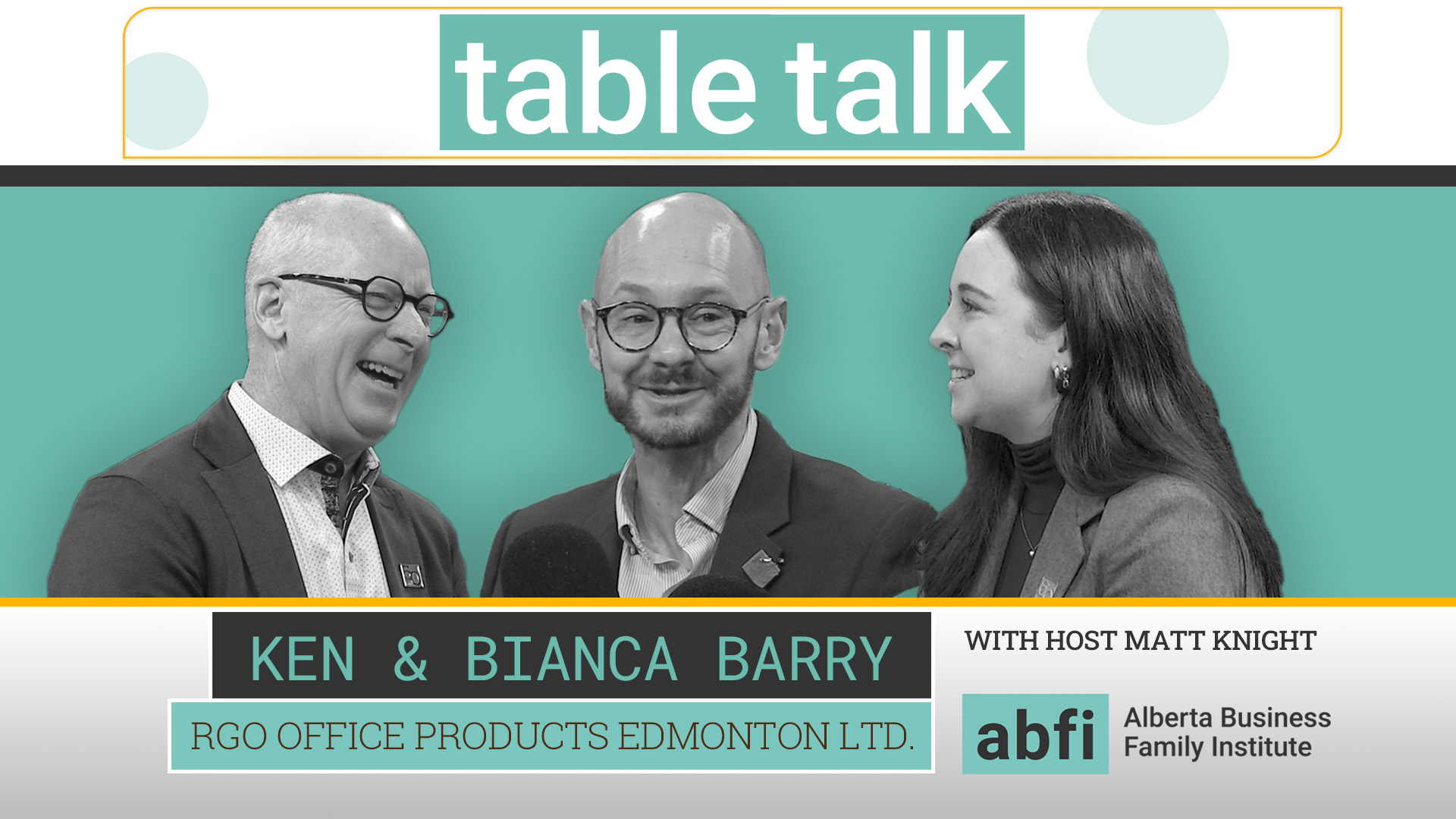
Most family business stories follow a familiar shape: someone starts a company, the next generation grows up around it, and succession surfaces down the road. Ken Barry's story breaks the pattern at step one — the family business he runs, RGO Office Products Edmonton, wasn't started by his family at all.
In 1996, Ken was at Steelcase Canada in Toronto, travelling the country as the industry's lead for financial institutions. RGO — founded in Calgary in 1966 by Ross Glen and his partner Gord Oliver (the source of the "RGO" name) — wanted to bring its brand to Northern Alberta and needed someone with local roots and entrepreneurial drive.
What followed was a handshake deal, a cross-country move, and a 30-year build now serving workplace, healthcare, education, and government across the region. In Episode 24 of ABFI Table Talk, Ken and his daughter Bianca sit down with host Matt Knight to trace what it means to build a piece of a family business rather than inherit one — and what it looks like when two families navigate generational transitions in parallel under one brand.
Ken's leap wasn't a master plan. It was, in his words, an opportunity that "serendipitously" presented itself when he learned about the Edmonton transition during a routine dealer visit.
"We worked out that it made sense for me to be the sweat equity, the local entity that would actually run the business," Ken recalls. "He was the finance part of it. We made a handshake deal, and away we went."
Ross provided the capital and the brand; Ken brought the entrepreneurial energy and carried the local risk. From day one, Ken positioned RGO Edmonton on three pillars: service, knowledge, and great products. "The product side is the easy part," he says. "We don't produce anything. We are a service entity." That clarity became the backbone of how he hired, trained, and grew the operation — and reflected his belief that Edmonton needed its own model, not a copy of Calgary's.
Bianca grew up around RGO — chasing her brother through the hallways, watching her dad set up office-lap races, and getting hired as a "sanitary engineer" with a written job description her 12-year-old brother also signed onto.
When the time came to choose a career, the path wasn't obvious. Bianca started in psychology at the University of Alberta, pivoted to Strategic Management, and credits student clubs and case competitions with pushing her "out of my shell" and giving her the confidence to consider joining RGO.
But she didn't go straight in. After a final semester abroad in Spain, she applied to Steelcase in Toronto — landing at POI, the same dealer where her dad had spent his early career and where her parents had originally met. Executives who had once bought her her first baby shoes were now her colleagues. "It allowed me to objectively look at the industry, see if I enjoyed it, and learn before joining RGO," she says. The pandemic accelerated the timeline. From a sidewalk on King Street, she called her dad. Ken opened a role for her, and she returned in early 2021.
What Bianca walked into on her first day is one of the quietly powerful moments in the episode. "There was an envelope on my desk," she recalls. "Whenever I came to RGO as a child, I would make notes as if I was working — calls that never happened, notes for my dad. He kept all those notes. They were in an envelope on my desk. It was very sweet."
Ken also set up meetings between Bianca and women leaders in Edmonton — Angela Santiago of The Little Potato Company, Nicole Janssen of AltaML, and others who had built businesses or grown into leadership inside a family one. The signal was deliberate: you have a community to lean on.
For Ken, the credibility question among Bianca's colleagues lasted "about two days." For Bianca, it took closer to a year of learning the dealer side from the inside. "I could speak all the research and knowledge," she says. "But there's a different art of understanding the community you're in, who's looking for space, and how we can help."
What makes the Barry story singular is its parallel. Cathy Orr — Ross Glen's daughter — leads RGO in Calgary, with her daughter Sarah and niece Cassandra now active in the business. The Glen/Orr family is moving from the second to the third generation. The Barrys are moving from the first to the second. Two families, two stages, one company.
Bianca has had welcoming conversations with Cathy, Sarah, and Cassandra — including a lunch in Calgary "with all the ladies" comparing notes on working alongside family. None of the next-gen members are deep into transition decisions yet, but the conversations have built rare peer relationships across two families navigating different generational moments inside the same enterprise.
Ross Glen passed away in March 2025. He had handed over day-to-day leadership long before, but stayed engaged right up to the final weeks. "It was a big loss as a friend, as a mentor," Ken says. "He had a swagger and a style that everyone recognized." What Ken returns to is what he learned from Ross about treating people well — language that surfaces in the legacy he hopes the Barry family leaves: "we put people first, and we treated people well — and we had some fun while we were doing it."
Bianca helped launch the WorkBetterLab — a Steelcase concept space in the Pendennis Building — to help Edmonton organizations rethink work post-pandemic.
"Your experience at work has to be better than the experience you can get at a third-party location," she says. "It has to be worth the commute." The line reframes the office as a designed experience competing with focus at home and the pull of a coffee shop. Her answer is agile, equitable space: whiteboards everywhere, furniture on wheels, focus rooms alongside collaboration zones, parity for whoever's joining remotely. Ken puts it plainly: "Your physical space matters, and people underestimate that."
The episode closes on advice for the next generation. Bianca's is lived: say yes to opportunities, and don't let imposter syndrome do the deciding. "I might as well jump in and give it a go. What's the worst that can happen?"
Ken builds the same theme from the other side. "You can learn from everybody, and you don't need to have all the answers." His book pick is Traction by Gino Wickman — the EOS framework RGO has been running for nearly a decade. Bianca's is Difficult Conversations.
Most family business discussions focus on a single question: how does one generation hand the company to the next? The Barry-RGO story is a useful complication — what's possible when a family builds a regional business inside a larger family enterprise, what shifts when the founder passes, and what it takes for two families to navigate transitions at different stages in real time.
For Canadian business families thinking about partnerships, regional expansion, or welcoming the next generation well, Ken and Bianca offer something rare: two generations both early in their own transitions, from inside an enterprise navigating two at once.
To learn more about ABFI's programs for family enterprises, visit abfi.ca. Connect with ABFI Executive Director Matt Knight at matt.knight@ualberta.ca or on LinkedIn. Learn more about RGO Office Products at rgo.ca.