On October 17, 1995, Ted LeLacheur signed a lease on an empty 10,000 square foot warehouse in Edmonton. No trucks. No equipment. No employees. Just a name that the moving industry already knew — and a gut feeling that he wasn't done.
Within days, former employees started walking through the door. "Ted, I hear you're back in business. Where do I sign my employment agreement?" They didn't need a business plan. They'd worked with Ted before. That was enough.
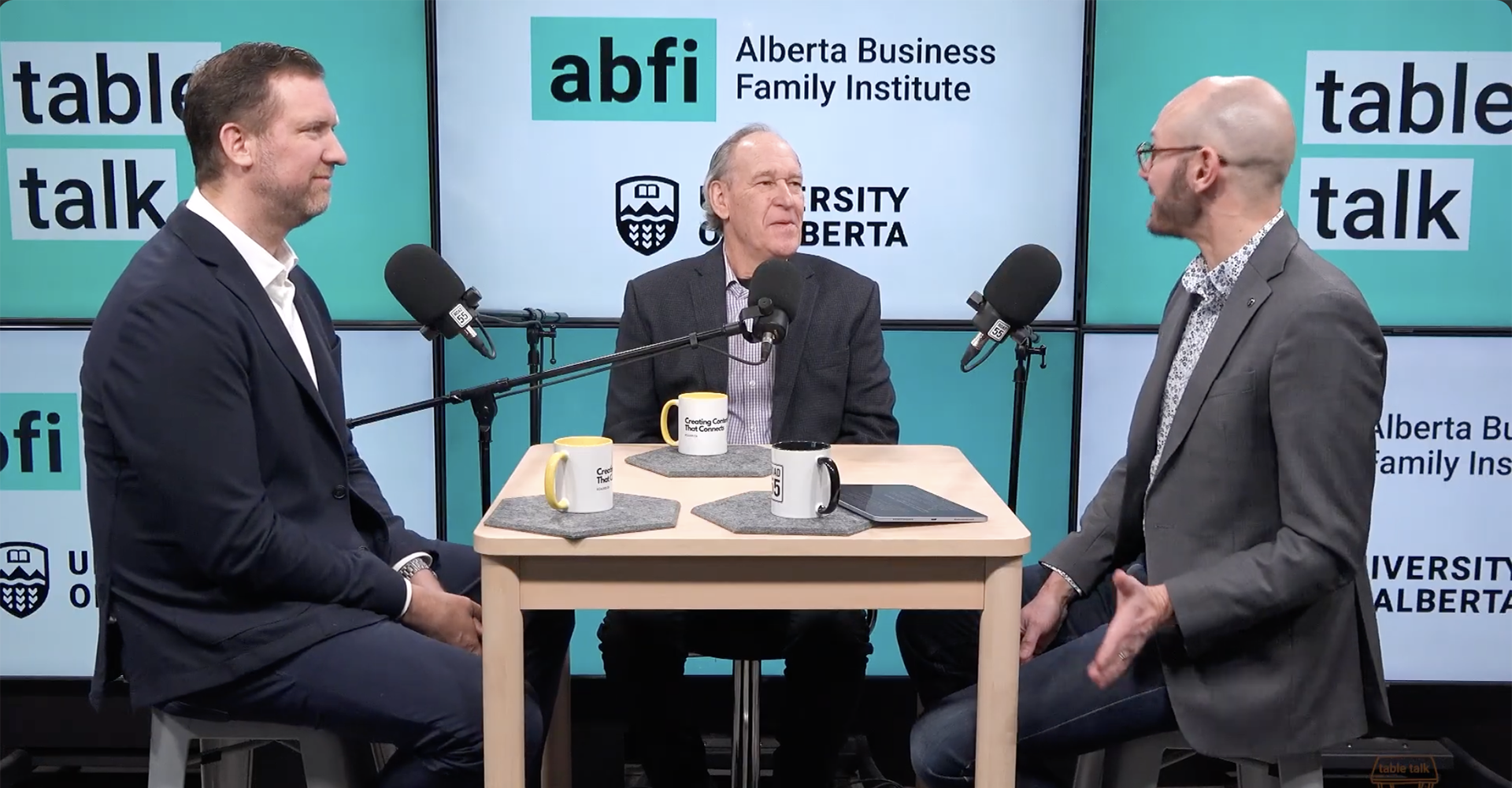
In a recent episode of ABFI Table Talk, host Matt Knight sits down with Ted and his son Sean LeLacheur for a candid, often funny, and deeply instructive conversation about what it takes to restart a family business, grow it across generations, and have the courage to make the moves that change everything — including one acquisition that started with a two-word response no one can repeat on a podcast.
The Decision to Start Over
The LeLacheur family has been in the moving business since 1906. By the time Ted and his brother Rick were leading the company, they had grown it to 25 locations and 400 employees across Western Canada. Then they sold. And for about a year and a half, Ted tried to move on.
He couldn't.
"There was something missing in my life," Ted says. "I don't know if it was the people or the pride that I always took in the moving and storage business. But my wife Carol and I made the leap in 1995 to restart the company."
It wasn't a calculated decision driven by a market gap. It was personal. People were still calling Ted to ask for moving help, unaware the family had exited. The reputation outlasted the company — and that's what convinced Ted and Carol they had something worth rebuilding.
The decision carries a lesson that transcends the moving industry: a family business built on genuine relationships doesn't disappear when the trucks do. The relationships are the business.
Next Generation, Next Chapter
Sean LeLacheur didn't follow a straight line into the family business. He worked summers and drove trucks through university, but when it came time to commit, Ted and Carol made a decision that many family business leaders wrestle with: they told him to go work for someone else first.
"Our company is not a perfect company," Ted explains. "It's important to go work for somebody else. My brother Rick and I went to Toronto on different occasions and worked with other movers — see how they did things. Maybe they were doing something different than we were."
Sean tried his own ventures. Some worked. Some didn't. Ted's assessment is characteristically blunt: "Financially, they were unsuccessful." Sean's reframe is just as quick: "Very successful learning."
When Sean came back, he started at the bottom. No special treatment, no corner office. And something clicked. "It was a genuine moment that I did want to come back," Sean says. "It was a really nice feeling coming back and kind of being where you belong."
For families navigating the question of when and how the next generation should enter the business, the LeLacheur approach offers a model worth studying: give them the freedom to leave, the space to fail, and the humility of starting over when they return.
The Big Fish and the Two-Word Answer
The defining strategic moment of Sean's leadership came when he proposed acquiring Matco Moving Solutions — a competitor founded in 1966 that was roughly three times Western Moving's size at the time.
Ted's reaction was immediate: "F off."
Sean, who describes himself as the "logical brain" to Ted's "emotional brain," had learned something important about working with his father. "When you present change, you get an instant reaction. So I got the response and I said, okay, I don't need the answer right now. Just think about it."
Over the course of a week, Sean presented the business case piece by piece. He also brought in Ted's brother Rick — who chairs the family's advisory board and had walked a similar acquisition path in an earlier era of the company. Rick understood the logic. And once Rick was on board, Ted could see it too.
"After he presented the full meal deal, it made sense to me," Ted admits. "The thought of purchasing the big fish was scary for me at my age — not for his age, but for my age. I wasn't prepared to sign another personal guarantee."
The acquisition went through. Today, Western Moving and Matco Moving Solutions operate as a combined force across Western Canada, and Sean sits on the board of United Van Lines, positioned to become chairman within four years. The little fish didn't just eat the big fish — it's now helping lead the pond.
For any next-generation leader preparing to bring a bold idea to the family table, Sean's approach is instructive: read the room, give the emotional reaction space to breathe, bring in trusted voices who can validate the logic, and let the numbers do the persuading.
Technology Meets a 100-Year-Old Industry
The LeLacheur conversation takes a fascinating turn when it shifts to technology. This is, after all, a business built on trucks, forklifts, and physical labor — the kind of industry most people wouldn't associate with AI.
But the reality is more nuanced. Sean has integrated AI-powered virtual survey tools that analyze home inventories with 85-90% accuracy, cutting the time it once took to drive hours to a client's home for an in-person estimate. Compliance monitoring systems, route optimization platforms, and digital operational tools now form the backbone of day-to-day operations.
Ted's perspective on the shift is honest and self-aware. "It scares the hell out of me," he says. "But I think it's like when the internet came in — everybody was afraid of it. And now, even being retired, I can't be without it."
Sean's approach to managing the change across a workforce that spans employees in their twenties to their late sixties is deliberate. "We spend a lot of time on change management and communication," he says. "It's going to come one way or another. So we're always talking about how to manage this change when it does come."
Looking ten years out, both see autonomous trucks as likely for domestic Canadian routes, though northern Canada's ice roads and extreme conditions will remain a human domain for the foreseeable future. Warehouse robotics are on the horizon, but the complexity of moving real households — with their infinite variability of items, layouts, and emotional stakes — will keep human hands at the centre of the work for a long time.
The Thread That Holds It Together
What makes the LeLacheur story more than a business case study is the consistency of values across generations. Ted built the company on a single principle: take care of your people, and they will take care of your customers. Sean has carried that forward while adding his own lens — creating opportunity for employees to grow, develop, and feel like they belong to something worth building.
They argue differently. They assess risk differently. Ted calls himself vintage; Sean calls him an emotional brain. But when it matters, they find a way to the same table — literally and figuratively.
As Matt Knight observes in closing: "Different eras, different challenges, but same family DNA. The LeLacheur story isn't just about moving. It's about what happens when each generation has the courage to reimagine the family business while staying true to the family values that got them there."
To learn more about ABFI's programs for family enterprises, visit abfi.ca. Connect with ABFI Executive Director Matt Knight at matt.knight@ualberta.ca or on LinkedIn. Learn more about Western Moving and Storage and Matco Moving Solutions at westernmoving.ca.